Participates at Verify
Evals
Test the exact candidate against acceptance, quality, security, and policy criteria.
Explore the Trust areaFactory Development Lifecycle (FDLC)Open framework · v0.1
The operating model and technical foundation for AI software factories that turn intent into verified software.
See a factory in action →For engineering leaders, platform teams, software-factory architects, and builders evaluating governed AI delivery.
Governs the lifecycle of software.
Governs the factory that builds it.
Code generation is becoming abundant. Trusted autonomous software delivery is not.
FDLC / Category promise
Verified delivery, not merely generated code.Autonomy without evidence is just faster guessing.The FDLC governing lifecycle
Select a stage to see what enters, what leaves, and what permits the work to move forward.
Stage 01 / 09
State the desired outcome, constraints, and accountable owner.
Agree on scope, acceptance criteria, risk, and ownership before delegating work.
Upgrade a vulnerable dependency. Preserve the public API and existing service behavior.
Learning closes the loop. Improvements return through verification and approval. This explorer illustrates the lifecycle; it does not execute work or grant authority.
Go deeper
Move from the factory overview to the chapters on design, agents, evidence, operations, and improvement.
One illustrative example
A software factory does more than generate a patch. It coordinates bounded work, returns evidence, preserves human authority, and produces a candidate that can earn release.
Upgrade a dependency across approved repositories without changing public behavior.
Plan → Modify → Test → Verify → Approve
Compatibility · Tests · Security · Cost · Human authority
A production-ready modernization candidate with an attributable evidence trail.
Interactive factory explorer
Follow one unit of workOpen on Framework →Choose a stage. Then inspect the capabilities it activates.Swipe the lifecycle
Stage 05 / Evidence · Verification
Evaluate the produced candidate independently and bind every finding to the exact subject.
Factory capabilities
9 of 10 participate at VerifyTest the exact candidate against acceptance, quality, security, and policy criteria.
Explore the Trust areaWhy FDLC
The factory begins with a governed outcome and acceptance contract.
Agents, models, and tools act inside declared operational limits.
Execution, verification, approval, release, and outcomes remain distinct.
Use FDLC now
Start with the depth that matches your question. Every path leads back to one governed system.
See one workflow move from intent to verified outcome.
Follow the five-minute example →AssessIdentify your current factory maturity and the next capability to earn.
Assess your factory →BuildTurn one engineering outcome into a reusable Factory Definition.
Build a Factory Definition →ReadUse the Guide as the field book for the deeper system.
Open the Guide →Open-source reference implementation
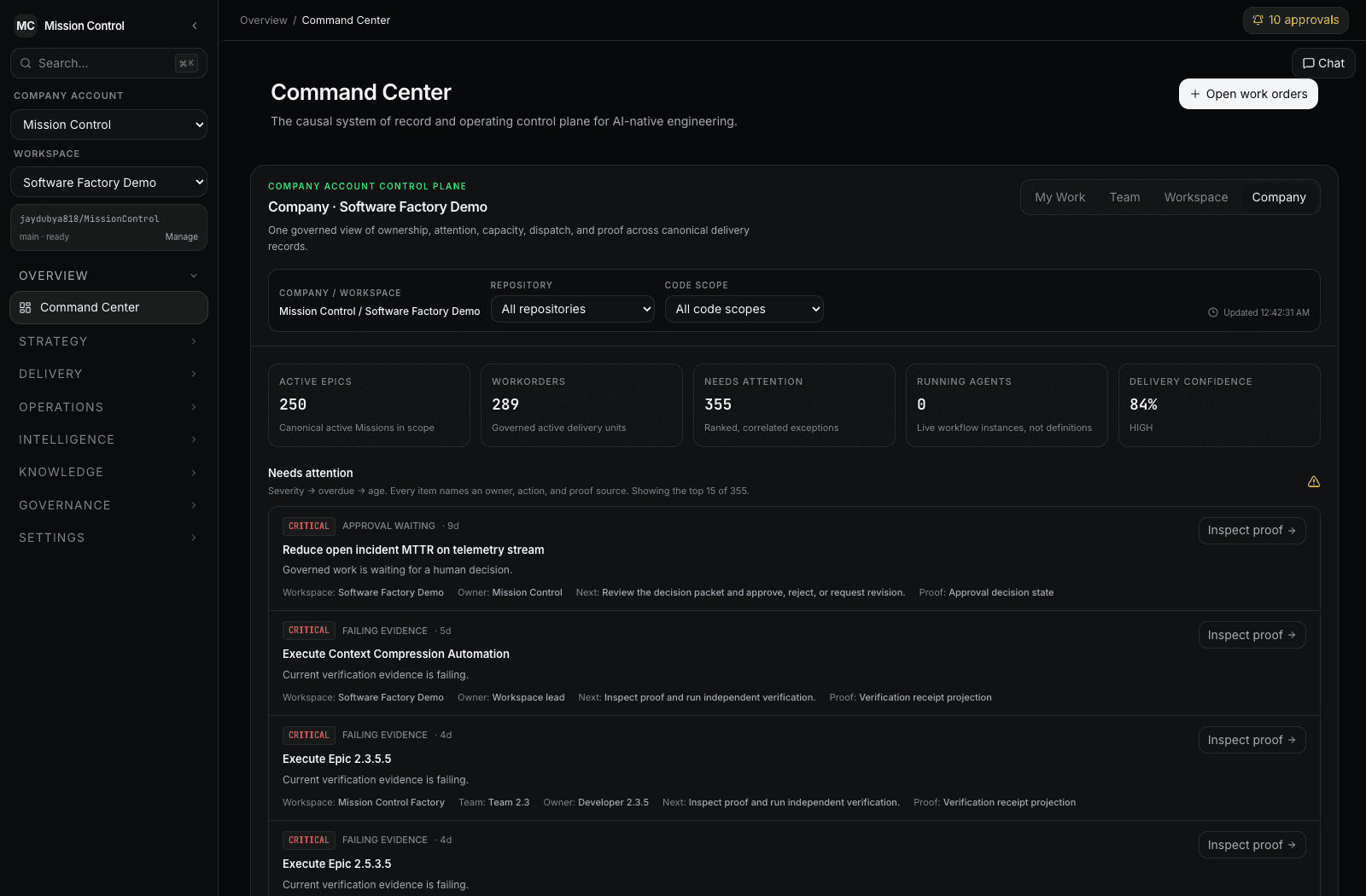
Inspect how plans, Work Orders, attempts, evidence, approvals, releases, and outcomes stay visible across autonomous software work.
What is real today
These labels describe current public status. They are not certification and they do not invent availability.
Open operating model and engineering discipline.
The field guide that teaches how to implement FDLC.
Open-source control plane with capability-specific evidence and limits.
Internal alpha with a synthetic demo. Discovers and designs a Factory Definition; a Factory Deployed Engineer remains the accountable human.
Local factory agent builder. No live model qualification yet.
Commercial multi-factory control plane. Not generally available.
Need help applying FDLC?
AI-FDE helps an accountable human Factory Deployed Engineer turn reviewed enterprise evidence into an approved Factory Definition for Mission Control validation.