One workflow. Four views. Eleven artifacts. One measurable outcome.
The Factory Development Lifecycle is the process for designing, assembling, governing, operating, measuring, and continuously improving an AI software factory.
This page walks one concrete factory line—dependency modernization—through the full system so you can see how FDLC turns intent into independently verified software.
This is not a product tour. It is a concrete walkthrough of the Factory Development Lifecycle applied to one bounded, high-value class of work.
One workflowFour system viewsEleven artifactsOne measurable outcome
The FDLC governing lifecycle
Follow the work. Inspect the controls.
Select a stage to see what enters, what leaves, and what permits the work to move forward.
FDLCWork earns progression.9 stages · one feedback loop
Stage 01 / 09
Intent
State the desired outcome, constraints, and accountable owner.
Input
A problem worth solving
Output
Intent contract
Control at this stage
Agree on scope, acceptance criteria, risk, and ownership before delegating work.
Example · dependency upgrade
Upgrade a vulnerable dependency. Preserve the public API and existing service behavior.
↺Learning closes the loop. Improvements return through verification and approval. This explorer illustrates the lifecycle; it does not execute work or grant authority.
01 / The factory line
Dependency modernization.
Upgrade a defined set of approved libraries across a single repository while preserving build integrity, test results, and public API compatibility.
INT-104 / Intent
Upgrade the Acme Payments SDK from v3 to v4 in checkout-api without changing public API behavior.
Repository
checkout-api
Risk class
Moderate · behavioral compatibility
Release owner
Payments platform lead
Factory version
dependency-modernization@1.0
SPEC-104-R1 / Acceptance contract
01
All existing contract and integration tests pass against the exact candidate.
02
No deprecated v3 imports or compatibility shims remain.
03
No public API, schema, or authorization behavior changes.
04
The release record includes rollback conditions and an accountable owner.
Baseline / illustrativeCycle timeDays to weeks
Elapsed time from admitted upgrade to accepted change
Human review minutesHigh
Compatibility, test-failure, and subtle-breakage review per accepted upgrade
Reopen / rollback riskMaterial
Accepted work that must re-enter governed execution or be reversed
Escaped defect potentialReal
Compatibility failures found after the release boundary
Worked reference scenario. Illustrative records and targets—not a production case study or benchmark result.
The goal of the factory line is not “run an agent.” It is to produce verified, accepted upgrades at lower cost, lower risk, and with less scarce human attention—while preserving a complete evidence trail.
02 / Four system views
The same factory. Four different questions.
FDLC is not one diagram. The views connect, but they are not interchangeable. Collapsing them produces confusion; keeping them separate produces clarity.
The factory line itself is engineered. It is not installed by prompting.
Discover, design, assemble, validate, deploy, operate, and improve the line under continuous governance, security, observability, and measurement. Evidence from real outcomes may propose a new version; it cannot silently rewrite the active line.
01
Discover
Select dependency upgrades as a repeatable factory line and record the current manual baseline.
Output · Measured opportunity
02
Design
Define eligible repositories, acceptance evidence, delegated authority, and escalation boundaries.
Output · Factory definition
03
Assemble
Bind the research, migration, test, repository, model, and verification capabilities.
Output · Runnable factory line
04
Validate
Run policy, recovery, and representative upgrade evals before the factory may operate.
Output · Validated factory version
05
Deploy
Promote dependency-modernization@1.0 with an environment binding and rollback plan.
Output · Active factory line
06
Operate
Receive eligible upgrade intent and execute the governed runtime lifecycle below.
Output · Verified software outcomes
07
Improve
Compare observed outcomes with baseline and propose a versioned factory change.
Output · Governed improvement
Across every stageGovernSecureObserveMeasure
Designed once. Run many times. Each run produces evidence that can improve the next run—under change control. The active factory version remains fixed until validated evidence justifies a governed improvement.
04 / Runtime lifecycle
One unit of work advances only by earning the next state.
Optimistic status labels are not sufficient. Runtime verbs move the work; artifact links point to the durable records that make every transition attributable and reviewable.
01
Receive
Record the desired SDK upgrade, owner, repository, constraints, and risk class.
These are representative semantic records, not a finalized wire format. Tasks, candidates, pull requests, and evidence envelopes may expand an implementation, but they cannot collapse the eleven canonical authority and evidence boundaries.
01
INT-104
Intent
Outcome, owner, repository, constraints, and risk.
What outcome matters?
02
SPEC-104-R1
Specification
Behavioral boundaries and criterion-level proof requirements.
What must be true?
03
PLAN-104-R2
Plan
Approved migration sequence, dependencies, verification, and rollback strategy.
How will the factory achieve it?
04
WO-104-01
Work Order
The bounded repository change authorized for execution.
What bounded unit is authorized?
05
ATT-104-03
Attempt
Identity, lease, environment, model, capabilities, and exact execution trace.
What exactly ran?
06
EVD-104-09
Evidence
Test receipts, typecheck, lint, dependency scan, and candidate diff.
What was observed?
07
VER-104-02
Verification
Independent judgment against the frozen Specification and exact candidate.
Does the evidence satisfy the specification?
08
APR-104-01
Approval
Named human decision, rationale, subject, and time.
May this consequence proceed?
09
REL-104-01
Release
Promoted artifact, policy currentness, owner, and rollback conditions.
What was promoted?
10
OUT-104-01
Outcome
Observed production behavior during the declared measurement window.
Did the intended result hold in reality?
11
LS-104-01
Learning Signal
Attributable improvement proposal without self-authorizing promotion.
What should change in the factory?
06 / Architecture participation
All six areas participate in the same run.
No single agent owns the outcome. Each architectural area contributes a distinct responsibility and maps to concrete Mission Control records or decisions.
01 / Intent
Define what should happen and how success will be judged.
Mission, Mission Spec, acceptance criteria, owner, repository, and risk class.
The control plane materializes the records, gates, and attention boundaries.
These reference-implementation views show where governed work, evidence, and decisions become inspectable. They demonstrate the operating model; they do not claim fleet-scale production certification.
Mission + SpecificationDefine the governed outcome and proof contract.
Versioned PlanMust be approved before Work Orders are released.
Leased AttemptsExecute against frozen configuration with durable lineage.
Evidence EnvelopesBind attributable proof to exact candidates.
Human acceptancePreserves accountable judgment at the consequential boundary.
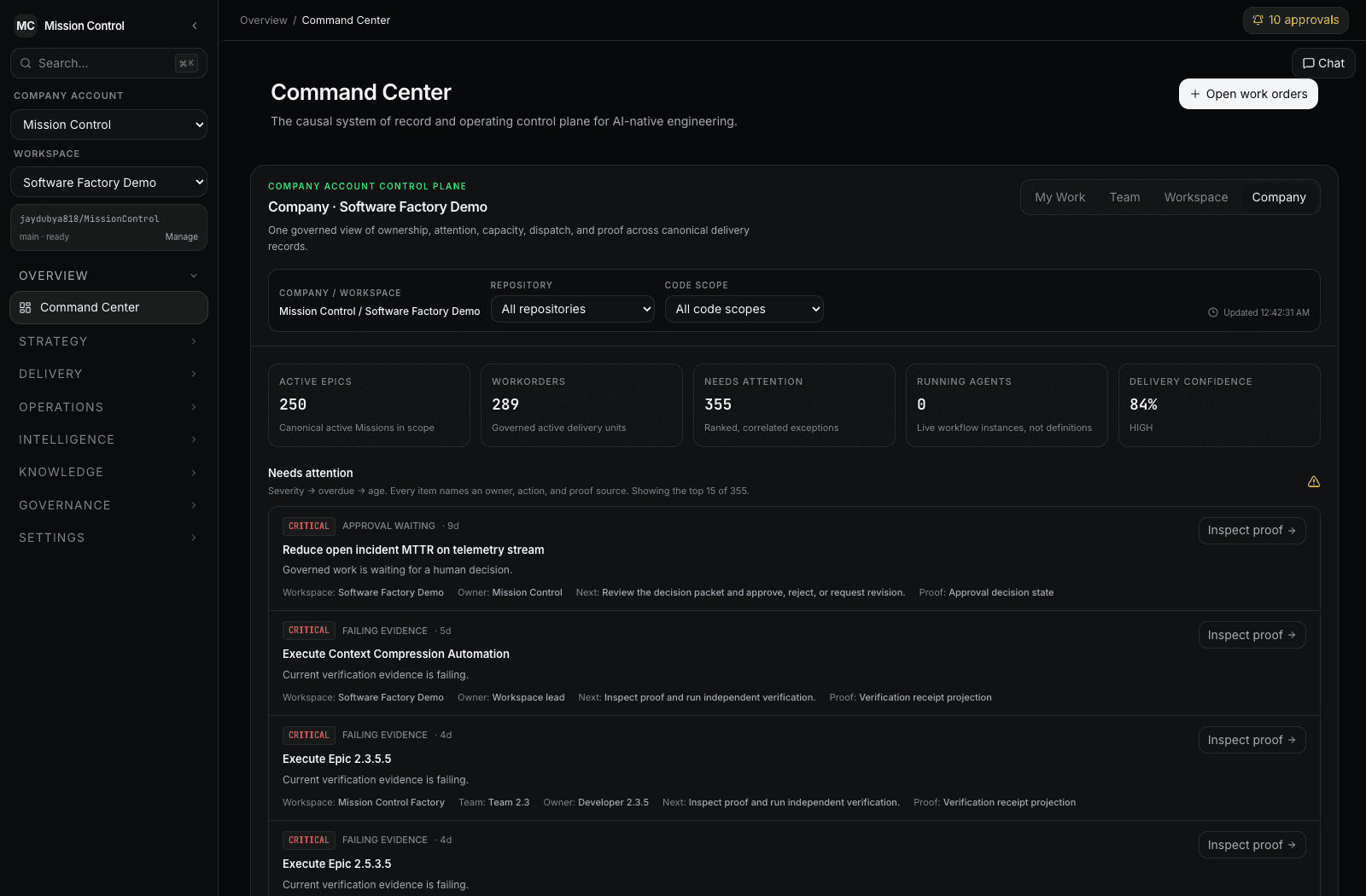
Command CenterReference view
Plan and approval boundaries stay visible.Governed work surfaces an owner, next decision, and proof source instead of disappearing into an activity feed.
Work OrderReference view
Execution is bounded before an Attempt begins.The Work Order carries scope, acceptance, risk, authority, and verification state; leased Attempts cannot silently become releases.
Audit and evidenceReference view
Evidence and consequential decisions become records.Verification, human acceptance, deployment, rollback, and policy decisions remain independently inspectable.
In Mission Control: Attempt completion → Quality Gate Decision → Human Acceptance → Release → Outcome. No single actor can advance more than one boundary without the required evidence and authority.
This walkthrough is a canonical example, not a certification of production readiness. The discipline is open. The reference implementation shows its limits. The value is determined by verified outcomes. Mission Control’s current capability boundaries are documented on the Mission Control page →