Factory Deployed Engineer
Owns the factory design and organizational outcome.
- Discovery
- Architecture
- Factory Definition
- Workflow decomposition
- Trust boundaries
- Evaluation strategy
- Rollout
- Organizational adoption
AI FACTORY DEPLOYED ENGINEER
Use AI-FDE to turn evidence about your engineering workflow into a reviewed Factory Definition. An accountable human Factory Deployed Engineer owns the design; Mission Control qualifies the runtime.
The operating team
AI-FDE is the product. The Factory Deployed Engineer is the human role that owns architecture, judgment, authority, adoption, and outcomes. Mission Control owns governed runtime qualification and execution.
Owns the factory design and organizational outcome.
Discovers and designs from reviewed enterprise evidence.
Governs the runtime and preserves the operating record.
AI-FDE in the FDLC ecosystem
FDLC defines the model. AI-FDE discovers and designs the factory. The human FDE owns the judgment. Mission Control governs qualification and execution.
Defines the operating model.
Discovers and designs it.
Owns it.
Governs it.
Executes it.
Proves it.
How AI-FDE works
AI-FDE assists the human FDE through six explicit stages. It does not silently promote inference to truth or approved intent to runtime.
Ingest enterprise source evidence and identify a bounded workflow worth modeling.
Extract candidate claims and model the current workflow without treating inference as truth.
Design target workflow, capabilities, execution architecture, economics, and authority boundaries.
Review the definition against readiness, verification, policy, rollout, and rollback requirements.
Prepare approved definition and qualification material for Mission Control validation.
Use independently verified runtime outcomes to inform controlled definition changes.
The primary design artifact
AI-FDE does not begin by choosing a model. It helps the human FDE define what the factory must produce, what may act, what evidence must return, where people decide, and how value will be measured.
The measurable outcome the factory should produce and the constraints it must respect.
The source workflow, target workflow, actors, systems, exceptions, and known unknowns.
The evidence and reviewed claims supporting each material part of the definition.
The agents, tools, skills, models, SDKs, harnesses, and implementations required.
Approved knowledge, retrieval boundaries, freshness rules, and attribution requirements.
The runtime, sandbox, Work Graph, orchestration, and recovery design.
Policy, delegated permissions, approvals, escalation, and accountable human decisions.
Independent acceptance criteria, evidence requirements, and failure handling.
Budgets, baseline assumptions, attributable cost, and value measurement.
Operational limits, observability, reconciliation, rollback, and rollout controls.
The technical, operational, and user results that will determine whether the factory worked.
Maturity, confidence, unresolved claims, and the conditions required before qualification.
The human-led engagement model
AI-FDE supports the evidence and design work. The human FDE owns the decisions. Scale remains conditional on evidence from real operation.
Understand the system and choose the right first factory line.
Build one real governed production line and prove whether it creates value.
Turn a proven line into organizational capability.
What AI-FDE produces
The primary output is an inspectable, attributable Factory Definition. Runtime qualification and execution remain separate Mission Control responsibilities.
A complete, reviewable specification for the line.
An evidence-backed description of how the selected workflow operates today.
The people, permissions, decisions, and escalation boundaries the factory requires.
The tests and evidence Mission Control must require before execution.
The evidence required before state may advance.
The before-state against which value is measured.
Attributable cost per attempt and accepted outcome.
Roles, exceptions, rollback, and day-two operating intent.
The agents, tools, profiles, and policy implementations to qualify.
Digest-bound approved intent for validation by Mission Control.
Good lighthouse candidates
The first line should be commercially relevant and operationally bounded. It should teach the organization how to trust the factory—not ask the organization to trust everything at once.
Upgrade libraries and frameworks with compatibility proof.
Replace deprecated interfaces with supported patterns and contract tests.
Find, fix, test, and verify known vulnerability classes.
Repair flaky tests, coverage gaps, and recurring static-analysis debt.
Detect stale technical documentation and validate it against source.
Produce evidence-backed findings while reviewers retain decisions.
Move brittle suites toward stable, meaningful behavioral proof.
Migrate repeated application patterns with explicit compatibility gates.
Repair repeatable delivery failures with observable acceptance criteria.
Good first factory lines have
Before / after
Define proof before execution
AI-FDE captures a measurement contract, not invented improvement claims. Real values appear only after Mission Control produces attributable execution evidence.
Organizational transformation
FDLC expands the builder population beyond people writing every line of code manually. Builders express intent, constraints, acceptance criteria, and authority while governed digital workers execute bounded work. Managers increasingly lead humans and digital workers.
The FDE
A Factory Deployed Engineer combines the disciplines required to make the line real and adoptable.
How the human FDE works with you
The human FDE leads the engagement with your experts while AI-FDE makes evidence, claims, decisions, and implementation intent inspectable.
The customer product
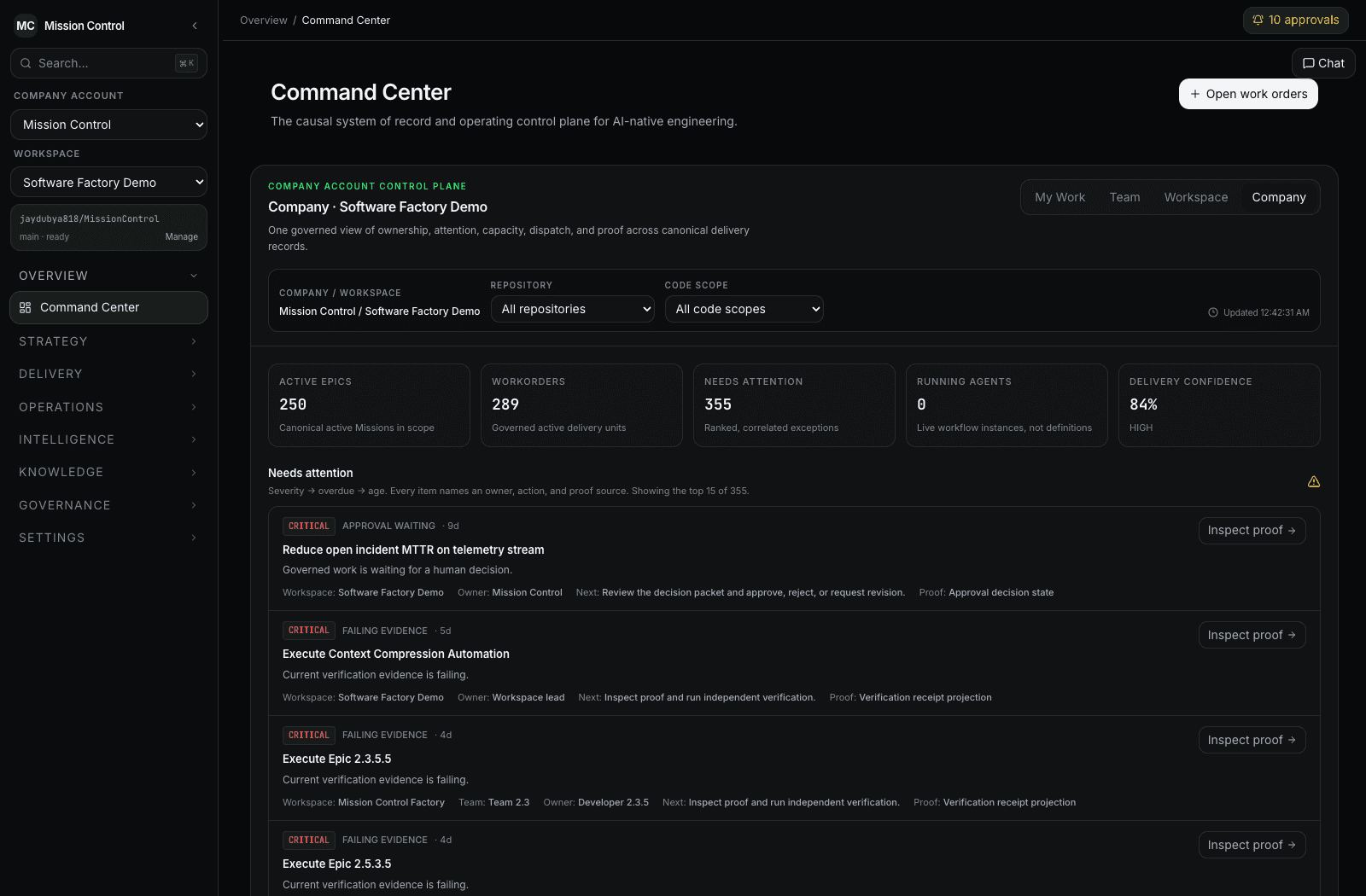
Mission Control is the operating dashboard delivered with the factory line. Your team sees work that needs attention, inspects bounded execution, reviews evidence, makes consequential decisions, and retains the audit trail.
Autonomy without abdicating control
Mission Control gives the team visibility into work, evidence, approvals, cost, and rollback. Agents may propose. Workers may execute. Verifiers may evaluate. Humans retain consequential authority. The control plane makes those boundaries enforceable.
Explore Mission ControlExecution complete ≠ Verified ≠ Approved ≠ Released ≠ Outcome proven
Design partnership
Begin with the maturity assessment and Factory Definition. Direct intake remains closed until the engagement and privacy paths are ready; the preparation tools are available now.
Current AI-FDE status
The public demo is deterministic and synthetic. Its source and browser gates are current, but this is not customer-operation, live-model, or Production-runtime evidence.
Evidence boundary
Factory Definition handoff
What should I do next?